Globalpay
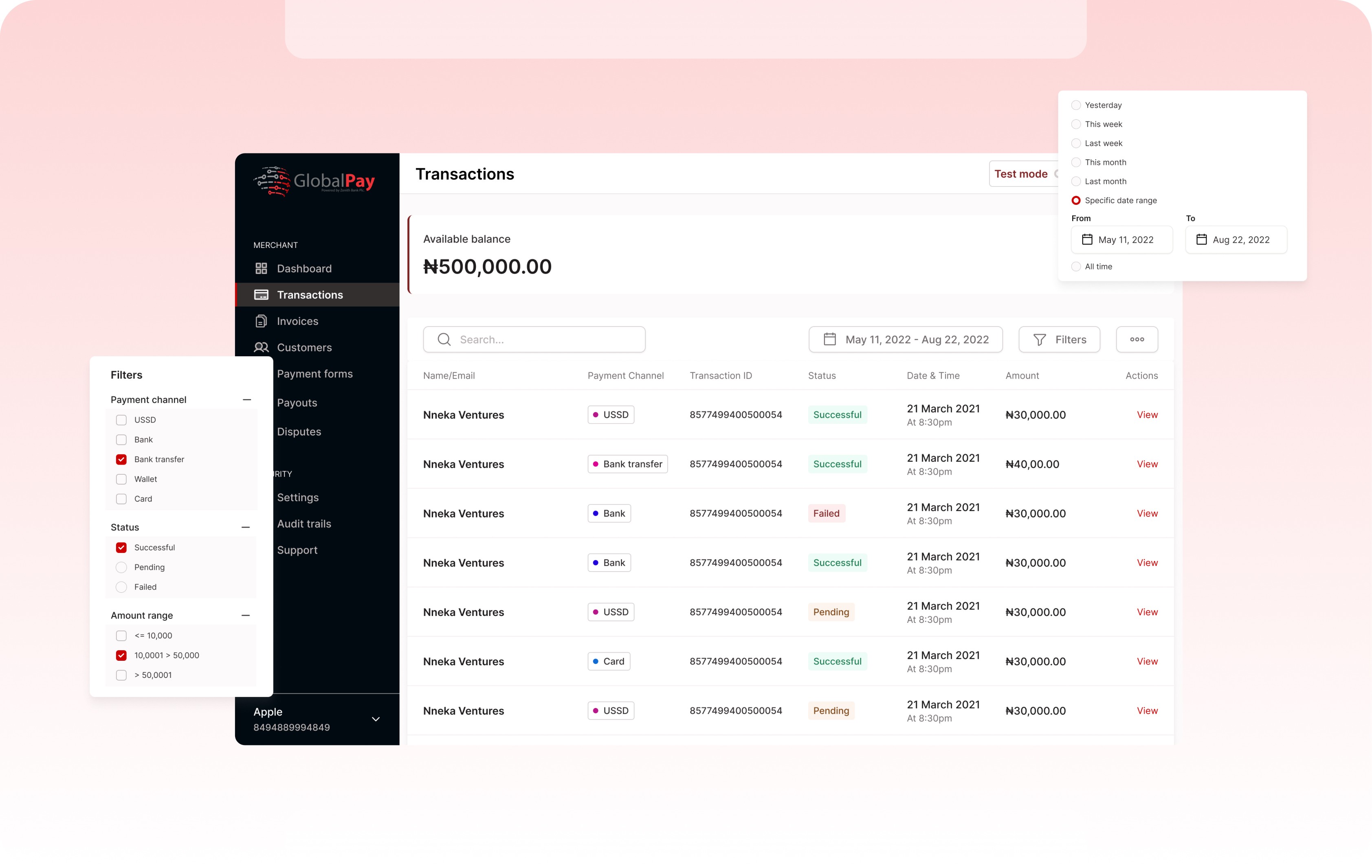
I was given the opportunity to redesign a payment gateway because the previous solution was clunky, lacked scalability, and suffered from poor UX
Role
Product Designer
Web Designer
Timeline
Nov 2022 - Jul 2023
Team
1 Designer (Lol, me 😄)
6 Engineers
2 PMs
1 QA
Skills
Product Design
Prototyping
User Research
Overview
GlobalPay is a secure, web-based gateway that enables businesses to accept real-time payments globally via local and international cards (Mastercard, Visa, Verve), QR codes, and USSD. By integrating directly into merchant websites, it provides a robust e-commerce platform that expands market reach and enhances sales through a seamless, multi-channel checkout experience
Key Metrics
Problem
Businesses were struggling with a payment gateway that felt more like a barrier than a bridge. The existing infrastructure was rigid, the interface was confusing, and the visual identity was disconnected from the brand's global ambitions.
Monolithic architecture didn't scale
The tightly coupled architecture created significant technical debt, making maintenance impossible and halting the addition of new features.
UX Inefficiency
A clunky, non-intuitive flow hindered productivity, leaving over 80% of users unable to complete complex tasks without assistance.
Brand Misalignment
The robotic and outdated visual identity failed to reflect the company’s modern brand, directly damaging merchant trust in a competitive global market.
Research
I combined qualitative and quantitative methods to understand the gap between the existing system and merchant needs.
Online Merchant Surveys
I gathered direct feedback from business owners to identify specific pain points in their daily payment processing workflows.
Stakeholder Documentation Analysis
I analyzed internal performance reports to pinpoint technical bottlenecks and architectural failures in the previous application.
Competitive Benchmarking
I conducted a UX and visual design analysis of competing payment apps to identify industry strengths and opportunities for differentiation.
User Consensus
Research confirmed that while automation was necessary for scale, merchants would only adopt it if the experience felt natural and aligned with their specific brand voice.
Solution
I designed a scalable payment gateway that prioritizes technical reliability and user autonomy through a high-performance, modular interface.
Progressive Disclosure Activation
I implemented a step-by-step activation flow to prevent cognitive overload, ensuring a fast and intuitive onboarding process for new merchants.
Error Visibility and Navigation
The interface provides clear feedback on user errors and simplified navigation, allowing merchants to troubleshoot and manage transactions with minimal friction.
Data-Driven Revenue Insights
I integrated clear, understandable revenue graphs that provide businesses with immediate visibility into their financial performance and global reach.
Minimal Interaction Cost
The redesign reduces the number of clicks required to achieve key goals, streamlining the daily operations for high-volume teams.
Scalable Design System
I built the product using a modular design system in Figma, ensuring that new features can be plugged in seamlessly without requiring a complete redesign.
Reflection
Reflecting on the project's scale, I realized that implementing semantic design tokens instead of local variables would have better future-proofed the system for subsequent designers and streamlined the technical hand-off as the architecture grew.
Next Project
Popcart